
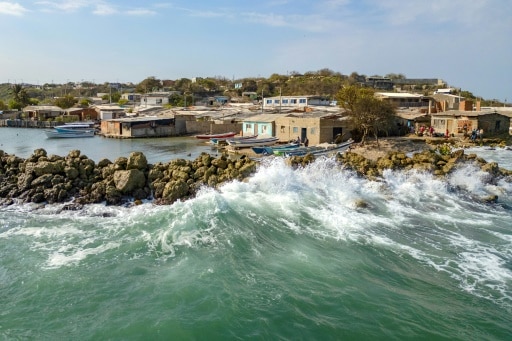
Carthagène (Colombie) (AFP) – Après Venise, Carthagène des Indes… Chaque année, le niveau de la mer monte et engloutit peu à peu la baie de la cité coloniale sur la côte caraïbe.
La ville la plus touristique de Colombie pourrait être partiellement submergée d’ici la fin du siècle, alertent les scientifiques.
Sur l’île de Tierra Bomba, face à la ville fortifiée de près d’un million d’habitants classée au patrimoine mondial de l’Unesco, l’eau a envahi en février un ancien cimetière, déterrant les crânes des défunts.
Mirla Aaron, une responsable communautaire de 53 ans, a été choquée de découvrir ces ossements, provenant de tombes si anciennes que personne n’est venu les récupérer.
Tombes éventrées
Au cours des dernières décennies, la mer « a détruit 250 maisons de la communauté, le poste de santé, les quais (…) elle a submergé plusieurs salles communautaires, les infrastructures électriques » et maintenant le cimetière, raconte Mme Aaron à l’AFP.
« Malheureusement, l’île a été victime d’un processus d’érosion (…) qui a augmenté de façon exponentielle au cours des dernières décennies », explique-t-elle.
« Carthagène sombre! » : La gravité de la situation a été révélée courant 2021 dans une étude publiée par la revue scientifique Nature, qui a suscité l’émoi de la presse colombienne.
Selon cette étude, depuis le début du 21e siècle, le niveau de la mer monte à Carthagène chaque année de 7,02 mm, contre 2,9 mm en moyenne dans le monde.
En cause tout d’abord, le réchauffement climatique qui affecte toute la planète, avec la hausse des émissions de gaz à effet de serre, provoquant la fonte des glaces aux pôles.
La mer dans la baie pourrait monter de 26 cm d’ici 2050 et de 76 cm d’ici 2100, affirment des chercheurs de l’université de Zagreb, de l’université internationale de Miami et de l’université locale EAFIT.
Mais, facteur aggravant pour le principal port commercial de Colombie, sa construction s’est faite sur un terrain comportant des cavités souterraines qui s’effondrent au fil des ans.
Fuir la mer
« L’élévation du niveau de la mer dans la zone côtière de Carthagène est due à deux facteurs », explique Marko Tosic, scientifique canadien spécialiste de l’environnement et l’un des auteurs de la publication.
En cause, d’abord le réchauffement climatique, mais aussi l' »affaissement du sol », qui se produit notamment « en raison de facteurs tectoniques ».
Il y a dix ans, Kelly Mendoza, 31 ans, a emménagé près du rivage sur l’île de Tierra Bomba. Depuis, deux de ses voisins ont perdu leur maison, emportée peu à peu par les eaux. Les vagues frappent déjà la paroi de sa maisonnette en briques, dans la pièce où elle dort avec son mari.
« Quand la vague frappe le mur, j’ai peur car c’est comme si la cloison allait tomber », que « j’allais me retrouver dans la mer avec mon lit », dit-elle.
La mairie n’a pas répondu aux demandes de l’AFP sur le nombre de personnes relogées en raison de l’érosion côtière.
A 87 ans, Inés Jiménez ne reconnaît plus l’environnement dans lequel elle a grandi.
Elle se souvient avoir dû déménager avec ses parents parce que leur maison avait été inondée.
Les gens « s’installaient un peu plus loin » pour échapper à la montée de la mer, raconte-t-elle, montrant au loin sur les flots l’endroit où, d’après ses souvenirs, se trouvait le trait de côte.
Nouvelle muraille
Marko Tosic prévient que la montée des eaux de la mer des Caraïbes est progressive, mais qu’elle est inéluctable.
Il s’agit d’un « très petit changement, nous parlons de millimètres au fil des ans ».
En 2024, les autorités doivent installer des épis de béton et des enrochements sur près de 4,5 kilomètres le long de la cité coloniale pour amortir l’impact des vagues.
Les travaux sont notamment visibles sur la plage de Bocagrande, front de mer avec de nombreux hôtels.
La mairie affirme que sans ça, la quasi totalité de la ville (80%), risquerait d’être inondée.
Mauricio Giraldo, un représentant des pêcheurs artisanaux, déplore cependant que le bouclier en construction ne protègera que les zones touristiques et les hôtels de luxe et dit son inquiétude pour les zones les plus pauvres.
© AFP
Ecrire un commentaire